Rental property maintenance from another city comes down to four habits: clear rules with your tenant, one place for requests, a short list of vetted providers, and photo proof of every job. Do those four things and a house you cannot visit stays in good shape.
This guide is for landlords who live out of town or out of state. We are Near.biz, a booking platform for home services in San Jose, Palo Alto and the cities between, so the examples and local rules lean toward the Bay Area. The steps work anywhere. Below you will find what maintenance covers, a system you can run from your phone, a yearly schedule, local rules, how to vet providers, and how the main ways of getting help compare.
Written by Tehreem for Near.biz. Last updated November 2026. Legal references were checked against the California Civil Code and City of Palo Alto sources.
In this guide
- What Rental Property Maintenance Covers
- Why Distance Changes the Job
- Four Kinds of Rental Maintenance Work
- How to Manage a Rental Property Remotely: A Six-Step System
- A Yearly Schedule for Bay Area Rentals
- Handling Requests and Emergencies When You Are Far Away
- Tenant Turnover: Cleaning, Inspection and Repairs
- Local Rules in San Jose and Palo Alto
- How to Vet a Rental Property Maintenance Provider
- Budgeting for Rental Maintenance Costs
- Three Ways to Handle Rental Maintenance, Compared
- Rental Property Maintenance FAQ
What Rental Property Maintenance Covers
Rental property maintenance is the regular upkeep that keeps a rental safe, livable and in good condition. It includes routine care such as servicing heating and cooling, repairs when something breaks, and cleaning between tenants. Larger upgrades, like a new roof, are improvements and are usually treated differently for budgeting and taxes.
Three words get mixed up, so here is the difference. Maintenance is planned upkeep, like changing an air filter. A repair fixes something that has stopped working, like a leaking faucet. An improvement adds value or replaces a major part of the home.
Who pays depends on the cause. In California, the landlord has to keep the home habitable, and Civil Code 1941.1 lists what that means, including working plumbing, heating and electrical systems and hot and cold running water. For leases that start on or after January 1, 2026, the list also includes a working stove and refrigerator, with a few exceptions. Tenants are generally responsible for damage they or their guests cause, and a lease can hand small tasks, like changing light bulbs, to the tenant.
Why Distance Changes the Job
Distance changes rental property maintenance because you cannot see small problems early. A slow drip under a sink turns into a damaged cabinet, a tenant waits days for an answer, and a repair gets done with nothing to show it happened. The trouble usually shows up in three places: slow response, no proof of work, and surprise bills. The system below is built to close those three gaps.
Four Kinds of Rental Maintenance Work
Rental maintenance work falls into four kinds: routine care, turnover between tenants, repairs on request, and emergencies. Each needs a different response time and often a different provider, from cleaning to plumbing, HVAC, electrical, appliance repair or gardening. Sorting a job into the right kind first tells you how fast to act and who to call.
| Kind of work | Examples | Who usually does it |
|---|---|---|
| Routine care | Heating and cooling service, filter changes, gutter cleaning, yard care, smoke alarm tests | HVAC, gardening, handyman |
| Turnover | Deep clean, move-out inspection, touch-up paint | Cleaning |
| Repairs on request | Leaking faucet, slow drain, dead outlet, fridge not cooling | Plumbing, electrician, appliance repair |
| Emergencies | Burst pipe, sparks or a burning smell, no heat in cold weather, no air conditioning in a heat wave | Plumbing, electrician, HVAC |
How to Manage a Rental Property Remotely: A Six-Step System
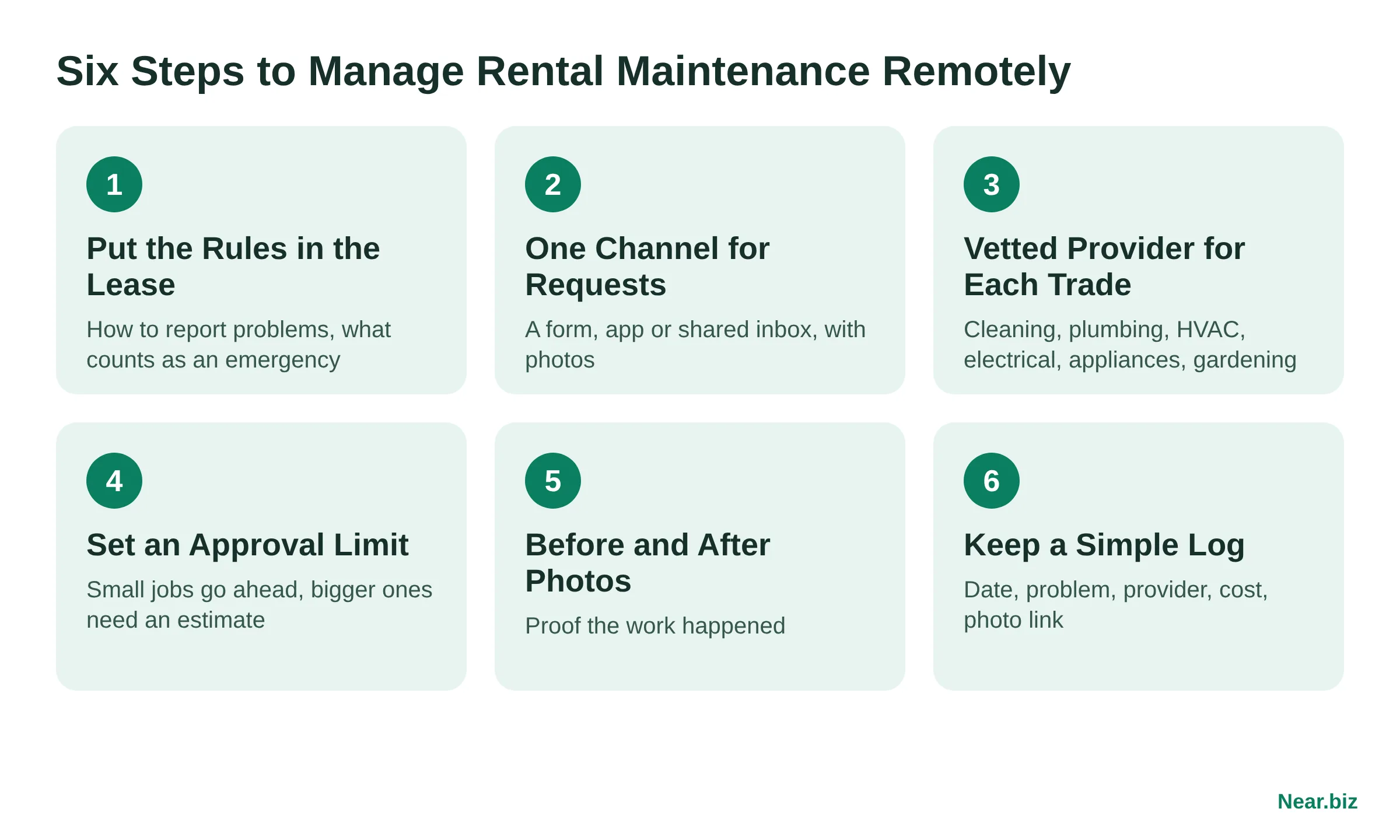
To manage rental property maintenance remotely, set the rules in your lease, give tenants one channel for requests, keep a short list of vetted providers for each trade, set a dollar limit above which you approve first, ask for before and after photos, and keep a simple log. Together these let you act fast without being there.
- Put the rules in the lease. State how tenants report problems, what counts as an emergency, and which small tasks they handle themselves. A written rule is easier to point to than a phone call.
- Use one channel for requests. Pick a form, an app or a shared inbox, and ask tenants to use only that. Every request then has a date, a description and photos in one place.
- Keep a short list of vetted providers for each trade. Aim for one cleaner, plumber, HVAC technician, electrician, appliance repair pro and gardener, plus a handyman for small jobs. Choose them before something breaks, using the questions in the vetting section below.
- Set an approval limit. Decide an amount under which a provider can fix the problem without calling you, and above which they send an estimate first. It keeps small jobs moving and stops surprise bills.
- Ask for before and after photos. Photos show that the work happened and what it looked like. They also help if you and a tenant later disagree about the condition of the home.
- Keep a log. A spreadsheet works. Record the date, the problem, the provider, the cost and a link to the photos. After a year it tells you what to budget and which problems keep coming back.
Here is a simple layout you can copy into any spreadsheet, with one sample entry:
| Date | Problem | Level | Provider | Approved first? | Photos | Status |
|---|---|---|---|---|---|---|
| Nov 3 | Heat not working | Emergency | HVAC provider | No, under my limit | Link to photo folder | Done |
If you would rather not build the provider list yourself, that is the part we do. See our rental property maintenance services for cleaning, plumbing, HVAC, electrical, appliance repair and gardening across San Jose, Palo Alto and nearby cities.
A Yearly Schedule for Bay Area Rentals
A yearly maintenance schedule for a Bay Area rental is simple: service heating and cooling before each season, clear gutters before the first rains, test smoke and carbon monoxide alarms twice a year, and keep the yard and sprinklers in order. Spreading the work across four seasons means nothing waits until it breaks.
| Season | Jobs to book |
|---|---|
| Spring | Air conditioning service before summer, sprinkler check, window and screen cleaning, look at exterior paint |
| Summer | Replace filters, check how well the air conditioning cools, yard care and watering |
| Fall | Heating service, gutter cleaning before the rains, smoke and carbon monoxide alarm test |
| Winter | Check for leaks after storms, look at the water heater and exposed pipes, test smoke alarms again |
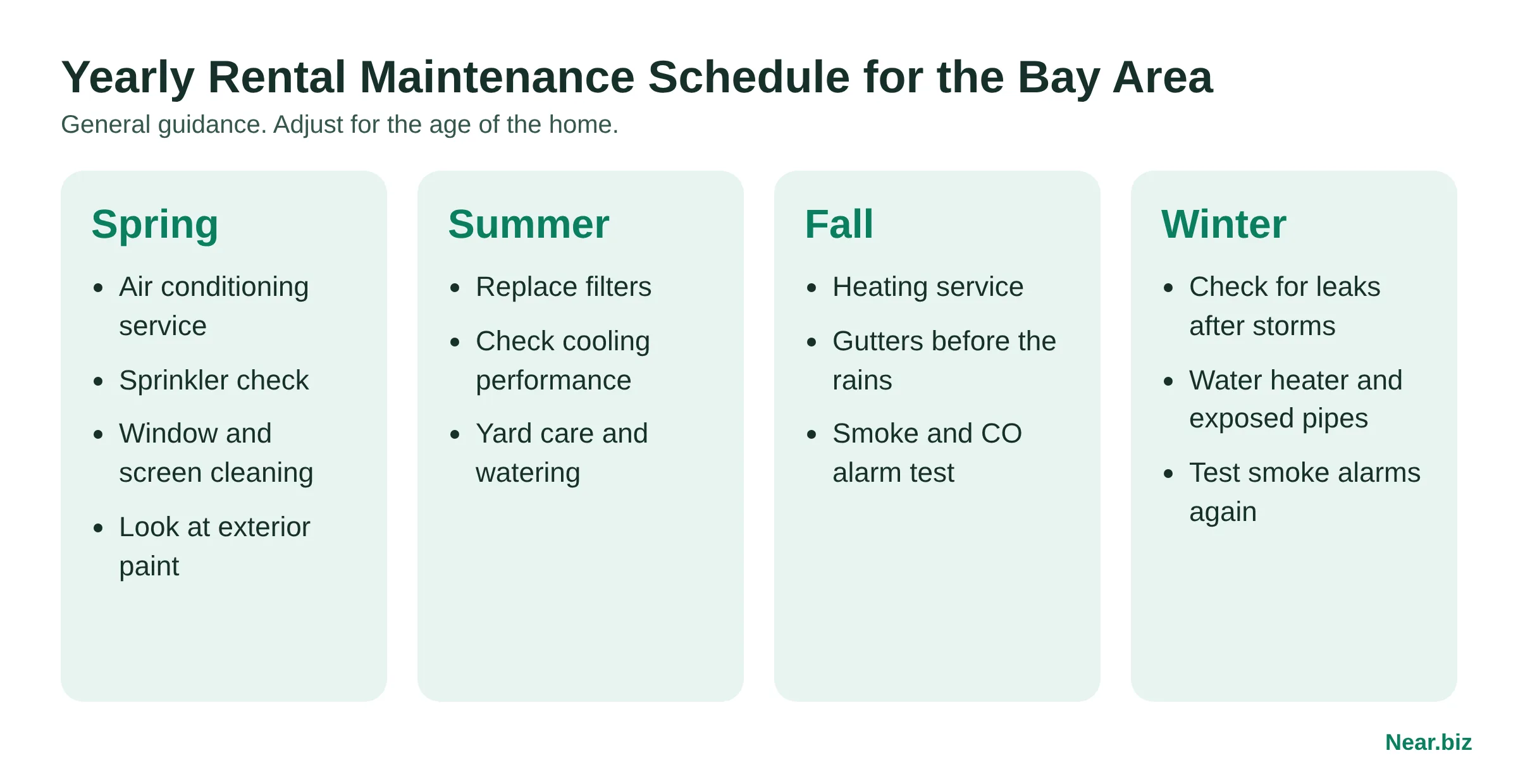
This is general guidance, so adjust it for the age of the home and what your HVAC installer recommends. Decide in the lease who handles rental property yard maintenance, since it is easy for each side to assume the other will.
Handling Requests and Emergencies When You Are Far Away
When a tenant reports a problem, sort it into an emergency, an urgent repair or routine work before you act. Emergencies, such as a burst pipe or no heat in cold weather, need a provider the same day. Urgent repairs can wait a few days, and routine work can be scheduled. Sorting first keeps small jobs from becoming expensive ones.
| Level | Examples | Suggested response |
|---|---|---|
| Emergency | Burst pipe, sparks or burning smell, no heat in cold weather | Same day |
| Urgent | No hot water, fridge not cooling, broken lock | Within a few days |
| Routine | Dripping faucet, loose cabinet door, touch-up paint | Scheduled, within 30 days |
The response times are our suggestions. For non-urgent repairs, the City of Palo Alto’s landlord guidance describes about 30 days as a reasonable window. If a tenant smells gas, they should leave the home and call the gas company and 911 before they call you.
Tell tenants what to do first, such as where the water shutoff valve is, and who to contact next. Write it in the lease or a move-in sheet.
Tenant Turnover: Cleaning, Inspection and Repairs
Tenant turnover is when most rental wear gets found and fixed. Between tenants, book a thorough cleaning, walk the home with photos to record its condition, and finish repairs before you list the next rental. Doing these in order shortens the empty weeks and leaves you a dated record if a deposit question comes up.
Start the cleaning booking as soon as you have a move-out date, because good slots fill up. If you cannot attend the walk-through, ask the cleaner or a handyman to take photos of each room, the appliances and any damage. Then list the repairs, book them in one visit where you can, and clean again if the repairs made a mess. Our move-out cleaning services page explains what a cleaning visit includes.
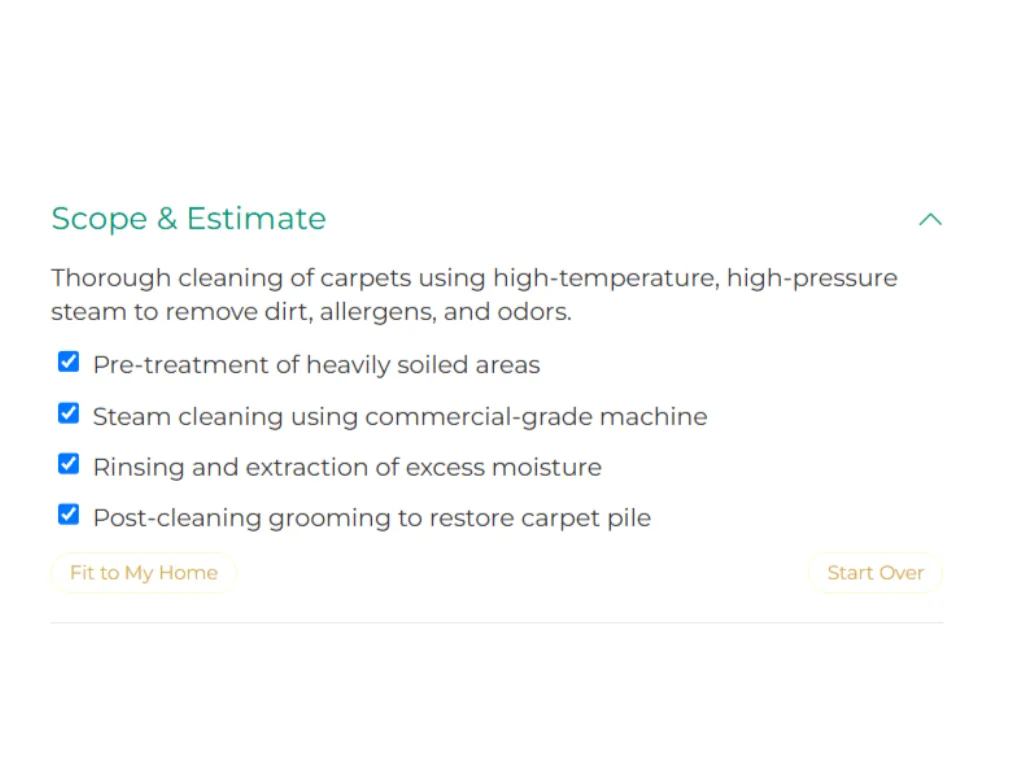
When you book a cleaning with us, you see the scope before you book. Carpets are a common add-on at turnover, and this is what the scope looks like for carpet cleaning.
Local Rules in San Jose and Palo Alto
In California, a landlord generally must give written notice, usually 24 hours, before entering a rental, and must keep the home habitable. Palo Alto also has landlord registration rules. Check your city’s current rules before you act, because local ordinances change.
- Entry notice. Under Civil Code 1954, written notice is required before entering, and 24 hours is presumed reasonable. The notice should state the date, an approximate time and the reason, and entry is limited to normal business hours. There are exceptions, such as emergencies. Plan provider visits around that window, and tell the tenant who is coming and when.
- Habitability. The home has to stay livable, so heating, plumbing and electrical problems are not optional repairs. For leases that start in 2026 or later, a working stove and refrigerator are part of the list too.
- Palo Alto. The city runs a Landlord Registry under Municipal Code Chapter 9.72, and a separate Rental Registry for properties with three or more units. Some owners of one or two units still have to file the Landlord Registry form, so check the Rental Registry Program page to see which applies to you. For entry notice and repairs, see the City of Palo Alto tenant and landlord guide.
- San José. The city has its own rental rules and a code enforcement office that handles housing complaints. Check the City of San José’s rental pages for the current rules on your property.
This is general information, not legal advice. If a situation involves a dispute or a notice to a tenant, talk to a California landlord-tenant attorney.
How to Vet a Rental Property Maintenance Provider
To vet a maintenance provider, confirm who they are, check that they hold any license or insurance the law requires for the job, ask how they handle price changes and payment, and ask how they report problems. A good provider answers these without hesitation and will put the answers in writing.
Ask every provider these questions before the first job:
- Who is the business owner, and can you see a photo ID and the company name and address?
- Does this type of work need a license in California, and can they show one that is current?
- Do they carry insurance for the job, where the law requires it?
- What happens if the price or scope changes once they see the problem? You want approval in writing before extra work begins.
- How do you pay, and will they ever ask for payment outside the agreed channel?
- How do they confirm arrival and report back when the job is done?
At Near.biz, we built our provider checks around the same questions. Near checks identity before a provider can take jobs. Where the law requires a license or insurance for a service, proof may be requested when the provider joins. Providers see the job scope and address before they accept, and any change to price or scope needs the customer’s written approval in Near before extra work begins. Near collects all payment, and providers may not ask customers for extra or outside payment. You can read the full policy on our Trust and Safety page.
Budgeting for Rental Maintenance Costs
Plan a rental maintenance budget as a share of rent or home value each year, then adjust it for the age and condition of the home. Older homes with original plumbing, heating or a worn roof usually need more than newer ones. Keep a reserve for emergencies so a single repair does not force a rushed decision.
Your log from step six is the best budgeting tool you have. After a year, you can see which jobs were routine and which were surprises, and set aside money for each. For a figure on your own home, enter your address on near.biz to see services and prices. Repairs and improvements are treated differently for taxes, so ask a tax professional how to record each one.
Three Ways to Handle Rental Maintenance, Compared
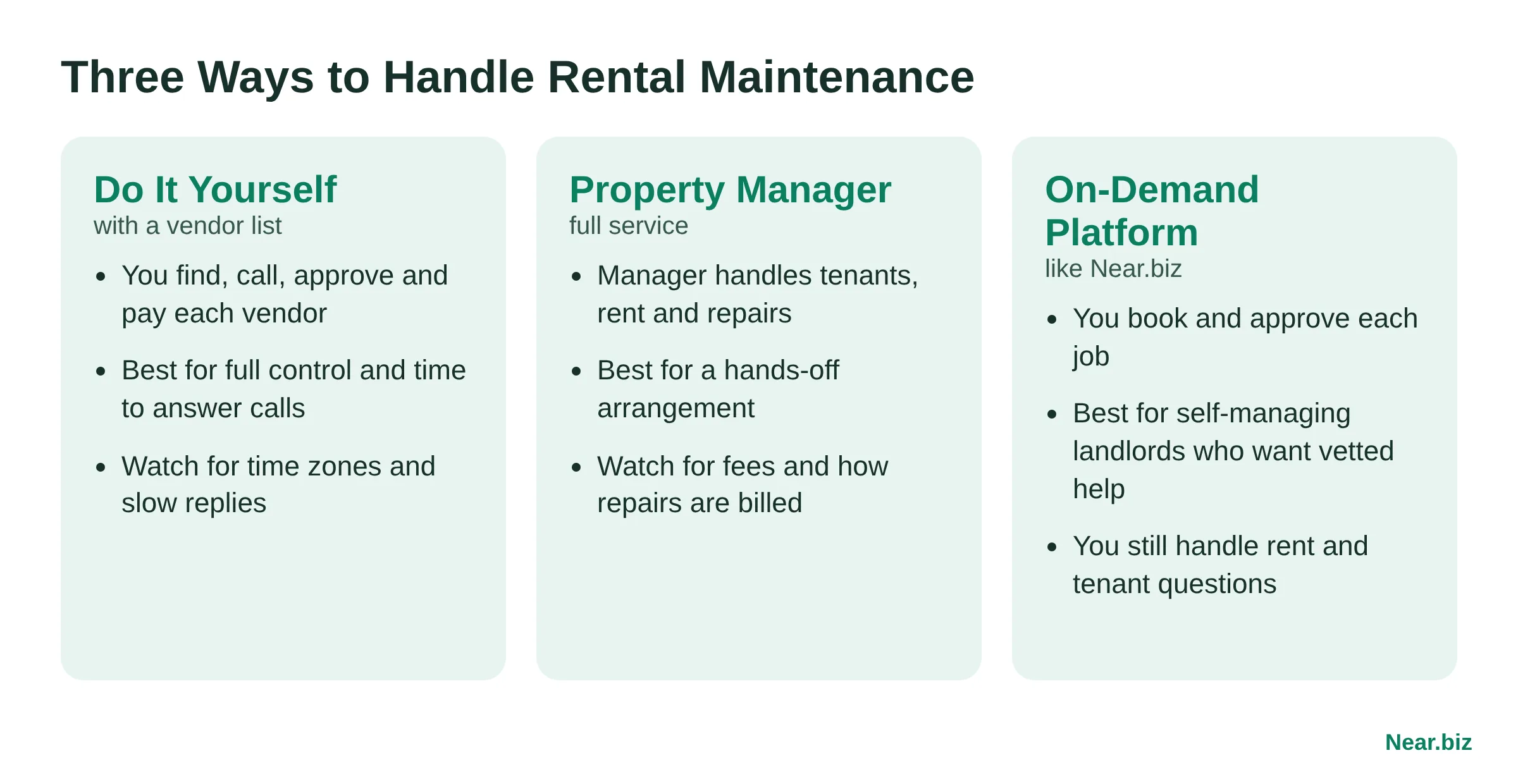
Landlords handle rental maintenance in three ways: doing it themselves with a list of vendors, hiring a full-service property manager, or booking jobs through an on-demand platform. The right choice depends on how much control you want, how many properties you own, and whether you want one company handling everything.
| Do it yourself with a vendor list | Full-service property manager | On-demand platform like Near.biz | |
|---|---|---|---|
| What you handle | Finding, calling, approving and paying each vendor | Very little, the manager handles tenants, rent and repairs | Booking and approving each job, plus your tenant relationship |
| Best for | Landlords who want full control and have time to answer calls | Landlords who want a hands-off arrangement for everything | Self-managing landlords who want vetted local help |
| Watch for | Time zones, slow replies, no one to send on short notice | Management fees and how repairs are billed, so ask before signing | You still deal with rent and tenant questions yourself |
A property manager is the better choice if you own several homes, have little time, or want rent collection and tenant screening handled too. If you want to stay in charge but not chase vendors, booking through a platform is a middle path. Our post on what makes a property manager efficient helps you judge one.
An Example Month for a San Jose Landlord
This is an example, not a real client. Maya lives out of state and owns a two-bedroom house in San Jose. She uses the six steps above.
On the first cold night of the year, her tenant reports that the heat is out. The tenant uses the one request channel, and Maya marks it an emergency. A vetted HVAC provider comes the next morning, fixes the problem and sends photos of the repair. The bill is under Maya’s approval limit, so she approves it with a message instead of a call.
Two weeks later, the tenant gives notice. Maya books a turnover clean, asks for room-by-room photos for the move-out walk-through, and sees a small paint touch-up in them. She schedules that in the same week. Before the rains, she books a gutter check.
That is three jobs in a month, no flights, and a log with dates and photos she can use at tax time or in a deposit dispute.
Rental Property Maintenance FAQ
Who Is Responsible for Maintenance of a Rental Property?
The landlord is responsible for keeping a rental safe and habitable, which includes working plumbing, heating and electrical systems. The tenant is generally responsible for damage they cause and for small tasks the lease assigns to them. Read the lease and your local rules, since the details vary by city and by situation.
What Is the Difference Between Maintenance and Repair?
Maintenance is planned upkeep that prevents problems, such as changing air filters or servicing a heater each year. A repair fixes something that has already broken, such as a leaking pipe. A larger upgrade that adds value or replaces a major part of the home is an improvement, and it is budgeted and taxed differently.
How Do I Manage a Rental Property Remotely?
To manage a rental property remotely, put maintenance rules in the lease, give tenants one channel for requests, keep vetted providers for each trade, set a dollar limit for approvals, and require before and after photos of every job. Keep a log of each request so you can budget and settle disputes with records.
How Quickly Should Repairs Be Done?
Emergencies, such as a burst pipe or no heat in cold weather, need a response the same day. Urgent repairs can wait a few days, and routine repairs should be scheduled promptly. The City of Palo Alto’s landlord guidance describes about 30 days as reasonable for non-urgent repairs, but check the rules for your city.
How Much Should I Budget for Rental Maintenance Each Year?
Many landlords set aside a percentage of rent or of the home’s value each year, then adjust for the age and condition of the property. Older homes need more. Track your actual repair costs in a log for a year, and keep a separate reserve for emergencies so one repair does not strain your finances.
Can I Hire Help Without a Property Manager?
Yes. You can hire vetted providers job by job, or book through an on-demand platform such as Near.biz, which covers cleaning, plumbing, HVAC, electrical, appliance repair and gardening in San Jose, Palo Alto and nearby cities. A property manager is a better fit if you also want rent collection and tenant screening handled.
Next Step: See Services and Prices for Your Rental
You do not need to apply every rental property maintenance tip at once. Start with the six-step system, write down your emergency rules, and book one provider you trust for each trade. If you want local help in San Jose, Palo Alto or the cities between, we can show you the services and prices for your home before you book.
About the Author
Tehreem is a content strategist and SEO writer. She writes Near.biz’s guides for landlords and homeowners and checks local rules against official city and state sources.