Written by Tehreem Fatima for Near.biz. Last updated November 2026.
An apartment make-ready checklist is the room-by-room list of checks, repairs, replacements and cleaning that takes a vacant unit from move-out to rent-ready. It tells you what to test in each room, what to fix, what to replace, and the order to do it in, so the next tenant moves into a unit where everything works.
Most make-ready checklists online are written for property managers running hundreds of units, with turn boards and software. This one is for landlords with one to ten rentals who do some of the work themselves and hire out the rest. It works the same way for an apartment, a condo, a duplex or a single-family house.
Use it alongside our tenant turnover checklist. The turnover checklist covers the whole timeline, from the tenant’s notice to the new lease. This make-ready checklist zooms in on the hands-on part in the middle: the days when the unit is empty and the work gets done.
Get the free printable: download the apartment make-ready checklist PDF (2 pages, with OK, Fix and Replace columns for every item).
In This Guide
- What Make-Ready Means
- The Make-Ready Order of Work
- Make-Ready Checklist for Apartments, Room by Room
- Repair or Replace? A Quick Guide
- Items Landlords Most Often Miss
- What a Make-Ready Costs
- Make-Ready Cleaning Checklist
- The Rent-Ready Standard
- What to Do Yourself and What to Hire Out
- How Long a Make-Ready Takes
- Make-Ready Checklist FAQ
What Make-Ready Means
Make-ready is the work of preparing a vacant rental unit for its next tenant: repairs, replacements, painting, flooring, safety checks and a final clean. The term comes from apartment management, where maintenance teams “make ready” a unit between leases. Small landlords often call the same job a turnover or a rent-ready prep.
Make-ready and turnover overlap, but they are not quite the same thing. Turnover is the full process, including the move-out inspection, the deposit, marketing and screening. Make-ready is the physical work inside that process. If turnover is the whole trip, make-ready is the part where you are actually driving.
A good make-ready does three jobs at once. It protects the next tenant, because alarms, locks and wiring get checked before anyone moves in. It protects your income, because a unit that is ready sooner earns rent sooner. And it protects you later, because a documented, working unit is your baseline if there is a deposit dispute at the end of the next lease.
The Make-Ready Order of Work
The order matters more than any single item on the list. The rule is simple: work from dirty jobs to clean jobs, so nothing has to be done twice.
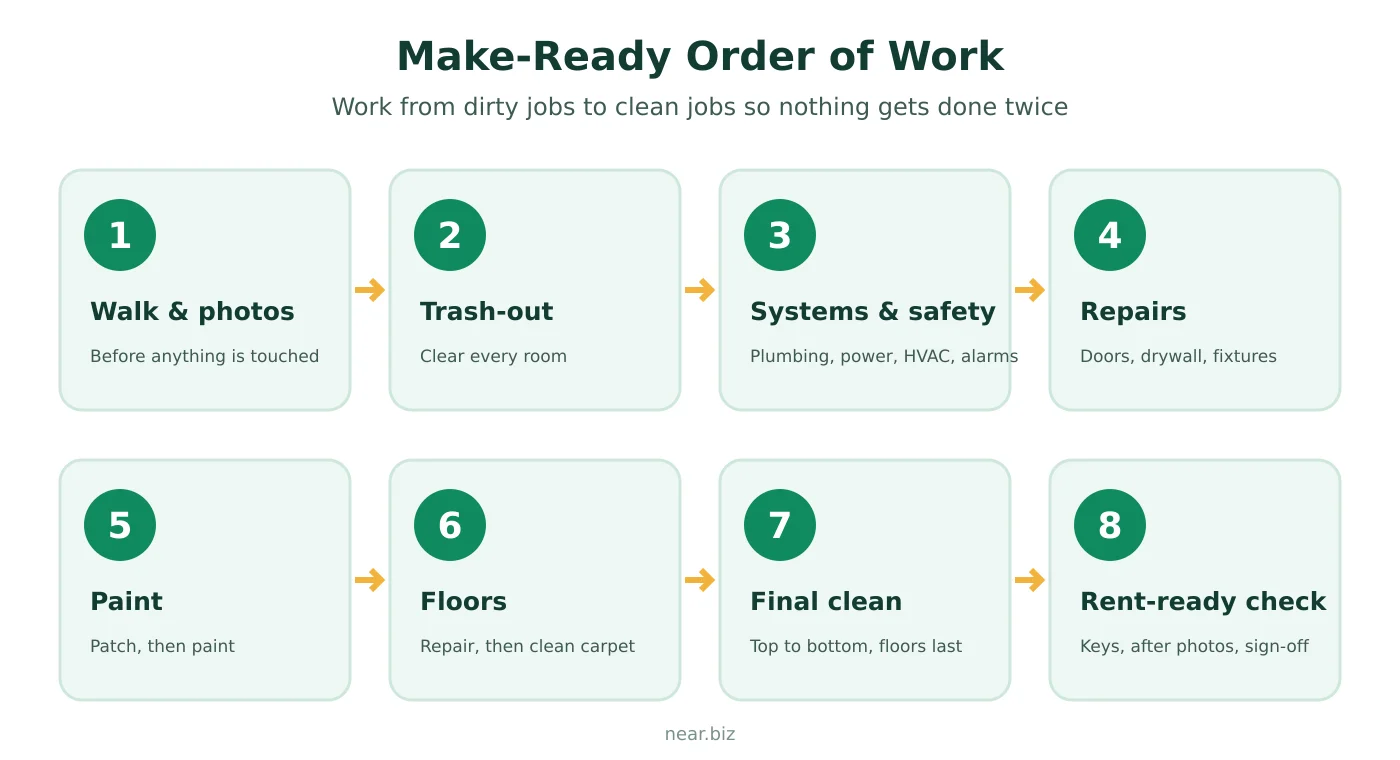
Here is the order in eight steps:
- Walk through and take photos. Photograph every room before anyone touches anything. This record matters for the deposit and for your next move-out inspection.
- Trash-out. Clear anything the tenant left, including the garage, storage and yard, so trades can see and reach what needs fixing.
- Systems and safety. Plumbing leaks, electrical problems, HVAC, appliances, smoke and carbon monoxide alarms. These come first because they can change the rest of the plan.
- Repairs. Doors, hardware, drywall, cabinets, fixtures and anything broken.
- Paint. Patch, sand and paint after the repairs, so you are not repainting a wall a handyman just opened up.
- Floors. Repair or replace hard flooring, then clean the carpets once heavy foot traffic is over.
- Final clean. Top to bottom, with the floors last.
- Rent-ready check. Test every key, take after photos and sign off the unit.
The most common and expensive mistake is booking the cleaner first. Drywall dust, paint drips and work boots undo a clean in an afternoon. If you want the day-by-day schedule for these steps, including what to book before the tenant leaves, the day-by-day turnover timeline lays it out.
Make-Ready Checklist for Apartments, Room by Room
Walk the unit in the same order every time, with the same list. Mark each item OK, Fix or Replace, and add a photo for anything that is not OK. The printable make-ready checklist has these same items in table form.
Entry, Walls and Doors
Start at the front door, because it is the first thing a new tenant sees and the first thing they lock.
- Walls patched, sanded and painted, with no nail holes, scuffs or tape marks
- Doors open, close and latch; door stops and hinges tight
- Locks rekeyed, and every key, fob and code tested (Near.biz lists lock rekeying with smoke detector checks)
- Light switches and cover plates clean and uncracked
- Baseboards and trim wiped and touched up
For scuffs and small patches in a few rooms, paint touch-ups are faster and cheaper than a full repaint.
Kitchen
The kitchen has the most moving parts in the unit, so run every appliance instead of just looking at it.
- Stove burners, oven and range hood fan all work
- Fridge cools, freezer freezes, door seals are intact, and the ice maker works or is switched off
- Dishwasher runs a full cycle with no leaks underneath
- Garbage disposal runs; no drips or water stains under the sink
- Faucet and sprayer have good pressure and no drips
- Cabinet doors and drawers are aligned, with tight hardware
- Countertops and backsplash have no chips, and the caulk is intact
- Outlets near the sink are GFCI and trip and reset correctly
A dripping kitchen faucet is a common find on a make-ready walk. Faucet maintenance is a quick fix to book while other trades work.
Bathrooms
Bathrooms hide slow leaks, so check under and behind things, not just the surfaces.
- Toilet flushes, refills and stops running; the base does not rock
- Tub, shower and sink caulk and grout are clean and sealed, with no mold
- Drains run clear and stoppers work
- Exhaust fan runs and actually pulls air
- Hot water reaches every tap; no drips at the faucet or shower valve
- Mirror, towel bars and toilet paper holder are secure
- GFCI outlets trip and reset
Bedrooms and Living Areas
These rooms are mostly about windows, closets and light.
- Windows open, close and lock; screens are intact
- Blinds work and are not bent or missing slats
- Closet doors run on their tracks; rods and shelves are secure
- Ceiling fans and light fixtures work, with matching bulbs
- Outlets work, with no loose, cracked or warm cover plates
Outlets that are loose, discolored or dead are worth fixing before a tenant plugs anything in. Near.biz’s home electrical service covers outlet and GFCI repairs, plus ceiling fans and exhaust fans.
Floors
Inspect the floors early, but repair and clean them late.
- Hard floors have no lifting boards, cracked tiles or loose transition strips
- Carpet stains, burns, pet damage and worn traffic paths are photographed
- Carpet is cleaned last, after every other trade has left the unit
When the rest of the unit is done, book carpet cleaning as the final trade before the deep clean.
Systems and Safety
This is the part of the apartment turnover maintenance checklist you cannot skip, even on a light turn.
- Every smoke alarm tested, with fresh batteries
- Carbon monoxide alarms tested, if the unit has fuel-burning appliances or an attached garage
- HVAC filter replaced; both heating and cooling tested
- Thermostat works and is set to a normal temperature
- Water heater shows no leaks or rust at the base, and the area around it is clear
- Fire extinguisher charged, if you provide one
- For homes built before 1978, the lead paint disclosure and EPA pamphlet are ready for the new lease
Check the date on the back of each smoke alarm, too. The National Fire Protection Association recommends replacing smoke alarms 10 years from the manufacture date printed on the device, not the date they were installed. A make-ready is the easiest time to swap out old ones. Near.biz lists smoke detector maintenance, and the EPA explains the lead paint disclosure rules for older rentals.
Exterior, Garage and Shared Areas
Finish outside, where small things are easy to forget.
- Entry light and doorbell work
- Mailbox key collected and working
- Garage door and opener work; all remotes collected
- Patio, yard and trash area cleared of anything left behind
- No signs of pests, such as droppings, nests or ant trails
If you see signs of pests, deal with them while the unit is empty. Pest control is much easier without a tenant’s furniture in the way.
Repair or Replace? A Quick Guide
Every make-ready forces small decisions: patch it again or replace it this time. There is no single rule, but these questions settle most of them:
- Is it a safety item? Alarms, locks, wiring, gas lines and anything that could hurt someone get fixed or replaced now, not next turn.
- Will it fail during the next lease? A water heater rusting at the base or a fridge that struggles to cool will likely become an emergency call later. Replacing it while the unit is empty is cheaper than replacing it around a tenant.
- Has it been repaired more than once? A faucet or disposal on its third repair usually costs more to keep than to replace.
- Does it affect the listing photos? Stained carpet, mismatched paint and dated light fixtures cost you applicants and days on the market.
- Is it damage or wear? Normal wear and tear is your cost. Tenant damage beyond normal wear may be deductible from the deposit, depending on your state. Our turnover checklist has a wear-versus-damage table with common examples.
For prices on common turnover jobs such as painting, carpet cleaning, drywall and rekeying, see the price table in our tenant turnover checklist. For cleaning specifically, our guide to move-out cleaning cost breaks down prices by home size.
Items Landlords Most Often Miss
A make-ready punch list usually catches the obvious problems. These are the items that slip through and turn into a call from the new tenant in the first week:
- The dishwasher and washing machine, which look fine but leak only when run
- Smoke alarms past their 10-year replacement date, even when the test button works
- GFCI outlets that are tripped, so a bathroom or kitchen outlet seems dead
- Window locks and screens in bedrooms that nobody opened during the walkthrough
- The range hood filter and the dryer vent, both fire risks when clogged
- The garage remote, mailbox key and storage key that never came back from the old tenant
- Burned-out bulbs in closets, exhaust fans and outdoor fixtures
Running every appliance and opening every window during the walk catches most of these.
What a Make-Ready Costs
Make-ready costs depend mostly on how much paint, flooring and repair work the unit needs, so a light turn can cost a few hundred dollars while a heavy one runs into the thousands. Industry surveys of apartment operators put the full cost of a turnover, including lost rent, at roughly $1,500 to $3,500 for most firms. Our tenant turnover checklist has the sourced figures and a worked lost-rent example.
The cheapest make-ready is the one that finishes sooner. Every empty day costs a day of rent, so booking vendors early usually saves more than shopping each job for the lowest quote.
Make-Ready Cleaning Checklist
Make-ready cleaning is a deeper clean than a regular house cleaning, because it covers the inside of everything a tenant will open. Do it last, once every repair, paint job and flooring job is finished.
A complete make-ready cleaning checklist covers:
- Inside every cabinet, drawer and closet, including shelves
- Inside and outside of the fridge, freezer, oven, microwave and dishwasher
- Range hood filter degreased or replaced
- Bathrooms scrubbed, including grout, fixtures, mirrors and behind the toilet
- Windows, sills and window tracks
- Light fixtures, ceiling fan blades, vents and baseboards dusted
- Doors, door frames, switches and outlet covers wiped
- Floors vacuumed and mopped as the very last step
- No odors and no trash left on site
You can do this yourself on a small unit, but it is a full day or more of work. Near.biz lists home cleaning that you can book by rental address, with the scope and estimated price shown before you approve it.
The Rent-Ready Standard
“Rent-ready” means a unit a new tenant could move into tonight without calling you tomorrow. Before you list or hand over keys, the unit should pass four tests:
- Everything works. Every light, outlet, appliance, faucet, lock and alarm, tested by hand.
- Nothing leaks. Under every sink, around every toilet, at the water heater and at the dishwasher.
- Every room is clean. Including the inside of cabinets and appliances.
- Every key is tested. On every lock it is supposed to open, including the mailbox and garage.
Then take a second set of photos, room by room, from the same angles as your move-out photos. These after photos become the move-in record, and pairing them with our rental inspection checklist gives you a signed condition report for the new tenant.
What to Do Yourself and What to Hire Out
Small landlords rarely hire out everything or do everything themselves. A practical split looks like this:
| Usually fine to do yourself | Usually worth hiring out |
|---|---|
| Walk-through, photos and the checklist itself | Electrical work beyond changing bulbs and cover plates |
| Replacing bulbs, HVAC filters and alarm batteries | Gas appliances, water heaters and HVAC repairs |
| Tightening hardware and adjusting doors | Plumbing leaks inside walls or under floors |
| Small paint touch-ups | Full repaints and drywall repair |
| Light trash-out | Carpet cleaning and deep cleaning |
| Testing appliances | Pest treatment and rekeying, unless you have the tools |
Licensing rules for electrical, gas and plumbing work vary by state and city, so check what your area allows an owner to do in a rental. When in doubt, hire a licensed pro for anything involving gas, wiring or water inside walls.
If you live far from your rental, most of the make-ready will be hired out, and your job becomes coordination: one list, one order, and photos as proof. Our guide to rental property maintenance for out-of-town landlords covers how to manage vendors from a distance, and the landlord services page lets you book several trades for one rental address.
How Long a Make-Ready Takes
Benchmarks published by property management software vendors put a light make-ready, with cleaning and a few touch-ups, at 3 to 5 days of hands-on work. A standard make-ready with paint and some repairs takes 5 to 10 days, and a heavy one with new flooring or major repairs can run two to three weeks. The total vacancy is usually longer, because finding and screening the next tenant takes time too.
Three things shorten a make-ready more than working faster:
- Book vendors before move-out. Cleaners, painters and carpet cleaners all have lead times.
- Order slow items early. Flooring, appliances and special-order parts can take longer to arrive than the rest of the work takes to finish.
- Let compatible trades overlap. A locksmith can rekey while a handyman fixes doors. A cleaner and a painter cannot share a room.
The day-by-day breakdown, with benchmark vacancy figures, is in the tenant turnover checklist. For the jobs you will repeat every season while the unit is occupied, use the rental property maintenance checklist.
Make-Ready Checklist FAQ
What is a make-ready checklist?
A make-ready checklist is a room-by-room list of the repairs, replacements, safety checks and cleaning needed to prepare a vacant rental for its next tenant. Landlords and maintenance teams use it to walk the unit after move-out, mark each item as OK, needing a fix or needing replacement, and confirm the unit is rent-ready before move-in.
What is the difference between make-ready and turnover?
Turnover is the full process of replacing one tenant with another, from the notice to vacate through the deposit, marketing, screening and new lease. Make-ready is the physical work inside that process: repairs, paint, flooring, safety checks and the final clean that get the empty unit ready for move-in.
What should be on an apartment make-ready checklist?
An apartment make-ready checklist should cover every room plus the unit’s systems: walls, doors and locks; kitchen appliances, sink and cabinets; bathroom fixtures, caulk and fans; windows, blinds and closets; floors and carpet; smoke and carbon monoxide alarms, HVAC and water heater; outside areas; and a final deep clean of every surface.
How long does an apartment make-ready take?
Hands-on make-ready work usually takes 3 to 5 days for a light turn with cleaning and touch-ups, 5 to 10 days for a standard turn with paint and repairs, and two to three weeks for a heavy turn with new flooring or major repairs. Booking vendors before move-out is the most reliable way to shorten it.
What is make-ready cleaning?
Make-ready cleaning is the deep clean done after all repairs and painting are finished, just before a new tenant moves in. It goes beyond regular cleaning to cover the inside of cabinets, closets and every appliance, plus windows, tracks, vents, fixtures and baseboards, and it ends with the floors so nothing gets tracked back in.
What is a make-ready punch list?
A make-ready punch list is the list of specific problems found during the walkthrough of a vacant unit, such as a dripping faucet, a dead outlet or a torn screen. The make-ready checklist tells you what to inspect, and the punch list records what actually needs fixing in that unit, so each item can be assigned and checked off.
Should I change the locks during a make-ready?
Yes. Rekey or replace the locks on every make-ready, because a former tenant, their guests or past contractors may still have copies. Test the new keys on every lock, including the mailbox, garage and any storage, and collect all fobs and remotes from the old tenant before you hand anything to the new one.
Book the Make-Ready Work for Your Rental
A make-ready goes faster when the cleaner, carpet cleaner and repair pros are lined up before the unit is empty. Enter your rental address on near.biz to see the estimated scope and price for each job before you approve anything.
See Services and Prices for My Rental
About the Author
Tehreem Fatima is a content strategist and writer at Near.biz, covering rental property management, landlord responsibilities, and home maintenance. She enjoys turning research into clear, practical insights that help landlords and property owners make informed decisions.